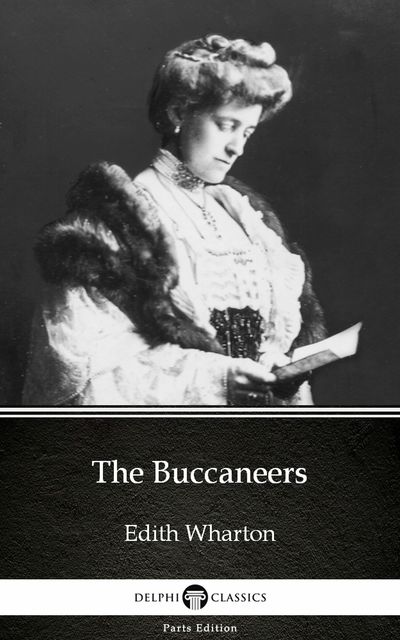
The Buccaneers
- Addie Barnettfez uma citaçãohá 13 dias
 St George, in her bewilderment, repeated this to her eldest daughter; and Virginia, who was a thoughtful girl, turned the matter over in her mind. The New York experiment, though her mother regarded it as a failure, had not been without its compensations; especially the second winter, when Nan emerged from the school-room.
 - Amazefez uma citaçãohá 8 meses
 “The great thing is that I shall be able to form her,” he had said to his mother, on the dreadful day when he had broken the news of his engagement to the horrified Duchess; and the Duchess had replied, with a flash of unwonted insight: “You’re very skilful, Ushant; but women are not quite as simple as clocks.”
As simple as clocks. How like a woman to say that! The Duke smiled. “Some clocks are not at all simple,” he said with an air of superior knowledge.All this amounteth not merely to alteration, but to wholesale exchange of character. In the series, Theo presenteth himself as a “gentleman”—certainly flawed, prone to projecting his ideals upon Nan, yet not overtly cruel. The conduct described here, however, reeketh of show-Seadown. And yet, thus far, Seadown in the book hath proven neither so controlling nor so malign. Theo, on the other hand…
- Amazefez uma citaçãohá 8 mesesI know — you’re a Mr. Robinson.”
Another great alteration concerneth the manner of Theo and Nan’s first meeting. In the series, they meet upon a beach; in the book, their encounter taketh place amidst the ruins of Tintagel Castle. There, too, Nan mistaketh Theo not for a painter, but for Hector Robinson—a detail both charming and significant, and wholly discarded by the adaptation.
- Amazefez uma citaçãohá 8 mesesOne especially, the fair one, had attracted him. She was less noisy than the others, and would have been an agreeable sight at the breakfast-table; and she carried her head in a way to show off the Tintagel jewels.
It is, I believe, upon such misreadings that the writers of The Buccaneers have built Theo’s affair with Lizzy, for in the book he regardeth her merely as “the fair one,” and no more.
- Amazefez uma citaçãohá 8 mesesShe lifted her sharp eyes to his. “You remember that the roof at Tintagel has still to be paid for?”
“Yes.”
“Dear Jean’s settlements would make all that so easy. There’s nothing the Hopeleighs wouldn’t do...”Here, too, we see that even as a Duke, Theo is not possessed of the extravagant wealth displayed in the series. In the book, his marriage to Jean is bound by settlement and necessity; in the show, he “must” marry her for reasons vague and unconvincing, untethered from material reality.
- Amazefez uma citaçãohá 8 mesesUnfortunately the Duchess had given him six daughters before a son was born, and two more afterward in the attempt to provide the heir with a younger brother;
HUGE DIFFRENT FROM THE SHOW!! just like how in the show Richard Marabel's siblings only include Hornia and Seadown rather than 5 sisters and two brothers. in books Theo have 8 sisters (6 older, 2 younger), while in the show hes the only child (and a said have half-brother, his father's bastard.)
- Amazefez uma citaçãohá 8 mesesShe hated the St George girls for having got ahead of her in their attack on London, but was instantly disposed to profit by the breach they had made. Virginia St George was not clever, and Lizzy would be able to guide her; they could be of the greatest use to each other, if the St Georges could be made to enter into the plan. Exactly what plan, Lizzy herself did not know; but she felt instinctively that, like their native country, they could stand only if they were united.
Lizzy's POV is so interesting. because in the show from s1, we could see how ambition she is but always cover herself with good persona. thats why many suprise of her switch up and how she betray nan with having affair with Theo. when lizzy, just like jinny, and nan is oportunits. thats why when her affair with Theo got exposed, rather than carry the blame with Theo, she quickly agree to Hector proposal to self herself from the blame. she saw opportunity and dont ashame to took it. its so sad that the series make her like some good girl that do what she do because nan hurt Theo first.
- Amazefez uma citaçãohá 8 mesesA young man that all the women are mad about, but who’s too poor to marry. The only kind left for the married women, in fact — so hands off, please, my dear. Not that I want Guy for myself
- Amazefez uma citaçãohá 8 mesesMy mother-in-law’s good- natured enough
Another notable difference lieth in Conchita’s own perspective: in the book, Richard’s mother is not portrayed as wholly cruel. Indeed, Conchita herself describeth her as “good-natured enough,” a nuance entirely stripped away in the adaptation.
- Amazefez uma citaçãohá 8 mesesI’ve looked like a fright ever since the baby was born. But he’s a grand baby, and they say I’ll be all right soon.
Likewise, in the book the girls encounter Conchita whilst her child yet resteth within her womb. In the series, however, Conchita and Richard are given a daughter, whereas in the book their child is a son. Moreover, in the book it is only Nan and Jinny who visit Conchita in England, whilst the series hath all the girls attend her—an alteration both needless and telling.